Introduction
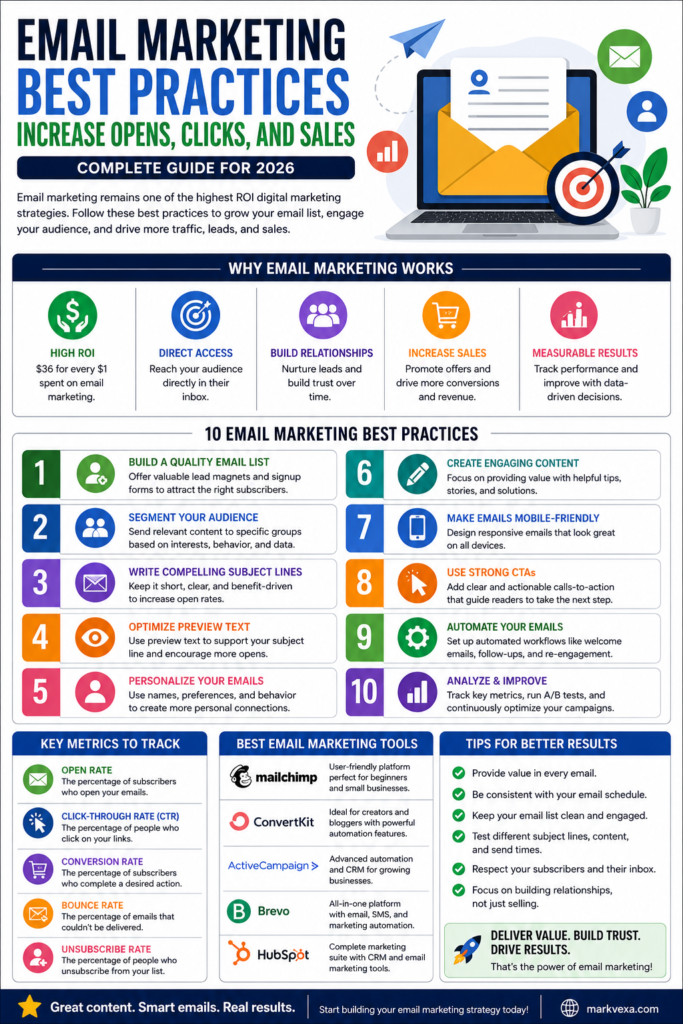
Despite the rise of social media, AI-powered search, and short-form video platforms, email marketing continues to be one of the most effective ways to connect with customers.
Unlike social media platforms, where algorithms control your reach, email gives you direct access to your audience. Every subscriber on your list has chosen to hear from you, making email one of the most valuable marketing assets for any business.
Whether you’re a blogger, affiliate marketer, eCommerce store owner, SaaS company, or small business, a well-planned email marketing strategy can generate consistent traffic, increase customer engagement, and drive long-term revenue.
However, simply sending emails isn’t enough. To stand out in crowded inboxes, you need valuable content, compelling subject lines, audience segmentation, and clear calls-to-action.
In this guide, you’ll learn proven email marketing best practices that can help improve your campaign performance in 2026.

What Is Email Marketing?
Email marketing is the practice of sending targeted emails to subscribers with the goal of building relationships, promoting products or services, sharing valuable content, or encouraging specific actions.
These emails may include:
- Newsletters
- Product announcements
- Promotional offers
- Educational content
- Affiliate recommendations
- Welcome emails
- Event invitations
- Customer updates
- Cart recovery emails
The objective is to deliver the right message to the right audience at the right time.
Why Email Marketing Still Works in 2026
Many marketers assume social media has replaced email marketing.
The reality is quite different.
Email continues to outperform many other digital marketing channels because it provides a direct and personalized way to communicate with your audience.
Unlike rented audiences on social platforms, your email list is an owned marketing asset. You have greater control over how and when you communicate with subscribers.
Email marketing is effective because it:
- Builds long-term customer relationships
- Drives repeat website visits
- Generates qualified leads
- Supports affiliate marketing campaigns
- Promotes products and services
- Encourages repeat purchases
- Increases customer loyalty
For many businesses, email remains one of the highest-return marketing investments available.
Benefits of Email Marketing
A successful email marketing strategy offers several important advantages.
Build Trust
Consistently delivering useful and relevant emails helps establish credibility with your audience.
When subscribers trust your recommendations, they’re more likely to engage with your content and purchase your products or services.
Increase Website Traffic
Every email creates an opportunity to bring readers back to your website.
Whether you’re promoting a new blog post, product review, or special offer, email can generate highly targeted traffic.
Generate More Leads
Email marketing helps move potential customers through your sales funnel.
Educational emails, downloadable resources, and exclusive offers encourage subscribers to take the next step.
Improve Customer Retention
Existing customers are often more valuable than new ones.
Regular communication keeps your brand top of mind and encourages repeat business.
Increase Sales
Strategic email campaigns can promote:
- New products
- Seasonal offers
- Affiliate recommendations
- Product launches
- Limited-time discounts
When combined with strong copywriting, email becomes a powerful sales channel.
Step 1: Build a High-Quality Email List
The success of your email marketing depends on the quality of your subscribers.
Avoid purchasing email lists.
People who never requested your emails are unlikely to engage, and sending unsolicited messages can damage your sender reputation.
Instead, focus on attracting subscribers who genuinely want your content.
Effective Ways to Grow Your Email List
Offer valuable incentives that encourage visitors to subscribe.
Popular lead magnets include:
- Free ebooks
- Checklists
- Templates
- Exclusive guides
- Mini courses
- Webinars
- Free tools
- Resource libraries
- Discount codes
The more valuable your offer, the higher your signup rate is likely to be.
Optimize Your Signup Forms
Make it easy for visitors to join your email list.
Place signup forms in strategic locations, such as:
- Homepage
- Blog sidebar
- End of articles
- Pop-up forms
- Landing pages
- Footer
- About page
Keep your forms simple.
Request only essential information, such as a first name and email address, to reduce friction.
Step 2: Understand Your Audience
Not every subscriber has the same interests or goals.
Understanding your audience helps you send more relevant emails that generate higher engagement.
Consider factors such as:
- Age
- Industry
- Job role
- Interests
- Purchase history
- Website behavior
- Preferred content types
The better you understand your subscribers, the easier it becomes to deliver personalized experiences.
Create Subscriber Personas
A subscriber persona is a profile that represents a typical member of your email list.
Example Persona
Name: Sarah
Profession: Small Business Owner
Goal: Increase website traffic
Challenges:
- Limited marketing budget
- Low Google rankings
- Inconsistent content creation
Interests:
- SEO
- Email marketing
- Content marketing
- Affiliate marketing
Personas help you create emails that address real problems and provide practical solutions.
Step 3: Set Clear Email Marketing Goals
Before launching a campaign, decide what success looks like.
Common goals include:
- Increase email open rates
- Improve click-through rates
- Generate affiliate commissions
- Drive website traffic
- Grow your subscriber list
- Increase product sales
- Promote new blog posts
- Improve customer retention
Every email should support a measurable objective.
Use SMART Goals
The SMART framework helps you create realistic goals.
Your objectives should be:
- Specific
- Measurable
- Achievable
- Relevant
- Time-bound
Example:
Increase email open rates from 28% to 35% within three months by improving subject lines and audience segmentation.
SMART goals make it easier to measure performance and optimize future campaigns.
Step 4: Write Irresistible Subject Lines
Your subject line is the first thing subscribers see.
No matter how valuable your email is, it won’t generate results if nobody opens it.
A strong subject line should:
- Be clear and specific
- Spark curiosity
- Communicate value
- Stay under 50–60 characters
- Avoid spammy language
Good Examples
- 10 SEO Tips That Actually Work
- Your Free Content Marketing Guide Is Ready
- Boost Your Website Traffic in 30 Days
- The SEO Mistake Most Bloggers Make
- How to Increase Email Open Rates
Avoid misleading subject lines that don’t match your email content. Trust is more valuable than a temporary increase in opens.
Use Action Words
Strong action verbs encourage subscribers to take immediate action.
Examples include:
- Discover
- Learn
- Improve
- Boost
- Increase
- Save
- Download
- Start
- Grow
- Master
Action-oriented language makes your emails feel more engaging and benefit-focused.
Step 5: Optimize Preview Text
Preview text appears next to or below the subject line in many email clients.
Think of it as a second headline that supports your subject line.
Example
Subject:
Increase Your Website Traffic in 2026
Preview Text:
Learn the proven SEO and content marketing strategies successful websites are using today.
A compelling preview text can significantly improve your open rate.
Step 6: Personalize Your Emails
People respond better to emails that feel personal.
Personalization goes beyond simply using a subscriber’s first name.
You can personalize based on:
- Interests
- Purchase history
- Website activity
- Location
- Previous downloads
- Content preferences
Relevant emails are more likely to be opened and clicked.
Segment Your Audience
Instead of sending the same email to everyone, divide your subscribers into smaller groups.
Examples include:
New Subscribers
Send:
- Welcome emails
- Beginner guides
- Helpful resources
Existing Customers
Send:
- Product updates
- Exclusive offers
- Loyalty rewards
Affiliate Marketing Audience
Send:
- Product reviews
- Software comparisons
- Special promotions
- Buying guides
Segmentation helps improve engagement because subscribers receive content that’s relevant to them.
Step 7: Write Engaging Email Copy
After your email is opened, the content must keep readers interested.
Great email copy is:
- Simple
- Conversational
- Helpful
- Easy to scan
- Focused on one goal
Avoid long walls of text.
Use:
- Short paragraphs
- Bullet points
- Clear headings
- White space
This improves readability on both desktop and mobile devices.
Focus on Benefits
Subscribers care more about results than features.
Instead of saying:
“Our SEO software includes advanced keyword analysis.”
Say:
“Find profitable keywords faster and improve your Google rankings with powerful keyword analysis.”
Benefits explain how your solution helps the reader.
Tell a Story
Storytelling makes emails more memorable.
For example:
- Share a customer success story.
- Explain how you solved a problem.
- Describe your own experience.
- Present a short case study.
Stories create emotional connections and make your message more persuasive.
Step 8: Design Mobile-Friendly Emails
Most emails are opened on smartphones.
A mobile-friendly email should include:
- Responsive design
- Large, readable fonts
- Short paragraphs
- Clear buttons
- Plenty of white space
- Fast-loading images
Always preview your emails on both desktop and mobile devices before sending.
Keep Your Design Simple
A clean design improves readability.
Best practices include:
- One-column layout
- Consistent branding
- Limited colors
- High-quality images
- Plenty of spacing
- Easy-to-read fonts
Simple emails often outperform overly complex designs.
Step 9: Use Strong Calls-to-Action (CTAs)
Every email should encourage readers to take one clear action.
Examples include:
- Read the full guide
- Download the free ebook
- Start your free trial
- Shop now
- Learn more
- Compare SEO tools
- Watch the tutorial
- Claim your discount
Keep your CTA visible and easy to understand.
CTA Best Practices
An effective CTA should:
- Be action-oriented
- Stand out visually
- Clearly explain the next step
- Link directly to the relevant page
- Appear naturally within the email
Avoid overwhelming readers with too many different CTAs in a single email.
Use Images Strategically
Images can make emails more engaging, but they should support—not replace—your message.
Best practices:
- Compress images for faster loading
- Add descriptive alt text
- Use relevant visuals
- Avoid large image-only emails
- Balance text and visuals
Remember that some email clients block images by default, so your email should still make sense without them.
Test Before Sending
Before sending any campaign, check:
- Subject line
- Preview text
- Personalization fields
- Grammar and spelling
- Links
- Images
- Mobile responsiveness
- CTA buttons
A quick review helps prevent errors and improves campaign performance.
Step 10: Automate Your Email Marketing
Email automation allows you to send the right email at the right time without manual effort.
Instead of sending every email individually, automation delivers messages based on subscriber actions.
Common automated campaigns include:
- Welcome emails
- Newsletter sequences
- Product recommendations
- Cart abandonment reminders
- Re-engagement campaigns
- Birthday emails
- Follow-up emails
- Post-purchase emails
Automation saves time while creating a more personalized experience.
Build an Effective Welcome Sequence
Your welcome email often receives the highest open rate of any campaign.
Use it to:
- Thank subscribers
- Introduce your brand
- Set expectations
- Deliver your free resource
- Recommend your best content
- Encourage readers to follow you on social media
A positive first impression helps build long-term relationships.
Step 11: Segment Your Email List
Not all subscribers have the same interests or needs.
Segmenting your audience allows you to send more relevant emails, leading to higher engagement.
You can segment subscribers by:
- Location
- Interests
- Purchase history
- Website activity
- Device type
- Industry
- Customer status
- Engagement level
The more relevant your emails are, the better they perform.
Step 12: Perform A/B Testing
A/B testing helps you discover what works best.
Test one element at a time.
Examples include:
Subject Lines
Test:
- Short vs. long
- Question vs. statement
- Personalized vs. generic
CTA Buttons
Compare:
- Learn More
- Get Started
- Download Now
- Read the Guide
Email Layout
Test:
- Images vs. no images
- Long copy vs. short copy
- Different button placements
- Different color schemes
Small improvements can significantly increase conversions over time.
Step 13: Send Emails at the Right Time
Timing affects open rates and click-through rates.
While the ideal time varies by audience, many businesses find success by testing weekday mornings or early afternoons.
Rather than relying on assumptions, analyze your own campaign data to identify when your subscribers are most active.
Review:
- Open rates by day
- Click-through rates
- Conversion rates
- Time-zone differences
Then schedule future campaigns based on actual performance.
Improve Email Open Rates
Higher open rates begin with trust and relevance.
To improve your open rates:
- Write compelling subject lines
- Use recognizable sender names
- Avoid spam-trigger words
- Keep your email list clean
- Send emails consistently
- Personalize your messages
- Deliver valuable content
- Segment your audience
A healthy email list usually performs better than a large but inactive one.
Increase Click-Through Rates (CTR)
Opening an email is only the first step.
Encourage more clicks by:
- Writing benefit-focused copy
- Using one primary CTA
- Placing links naturally
- Making buttons easy to find
- Creating urgency where appropriate
- Linking to relevant landing pages
The easier it is for readers to take action, the more likely they are to click.
Increase Email Conversions
Conversions occur when subscribers complete your desired action.
Examples include:
- Purchasing a product
- Signing up for a webinar
- Downloading an ebook
- Registering for a free trial
- Reading a blog article
- Joining your community
Improve conversions by:
- Matching the email to the landing page
- Reducing unnecessary distractions
- Using clear messaging
- Building trust with testimonials
- Offering genuine value
Consistency between your email and landing page creates a smoother user experience.
Monitor Key Email Marketing Metrics
Successful marketers regularly analyze campaign performance.
Important metrics include:
- Open Rate
- Click-Through Rate (CTR)
- Click-to-Open Rate (CTOR)
- Conversion Rate
- Bounce Rate
- Unsubscribe Rate
- Spam Complaint Rate
- Revenue per Email
- List Growth Rate
Tracking these metrics helps identify strengths and areas for improvement.
Keep Your Email List Healthy
Maintaining a clean email list improves deliverability and engagement.
Best practices include:
- Remove inactive subscribers
- Delete invalid email addresses
- Respect unsubscribe requests
- Use confirmed (double) opt-in when appropriate
- Avoid purchased email lists
- Monitor spam complaints
A smaller, engaged audience is often more valuable than a large inactive list.
Best Email Marketing Tools
The right tools make campaign management easier.
Mailchimp
Best for:
- Beginners
- Small businesses
- Email templates
- Automation
ConvertKit
Best for:
- Bloggers
- Content creators
- Email automation
- Audience segmentation
Brevo (formerly Sendinblue)
Best for:
- Transactional emails
- Marketing automation
- CRM integration
ActiveCampaign
Best for:
- Advanced automation
- Customer journeys
- Lead nurturing
- Sales automation
HubSpot
Best for:
- Marketing automation
- CRM
- Email campaigns
- Lead management
Common Email Marketing Mistakes
Avoid these mistakes:
- Buying email lists
- Sending too many emails
- Ignoring mobile users
- Using misleading subject lines
- Forgetting to test campaigns
- Sending irrelevant content
- Using multiple competing CTAs
- Ignoring campaign analytics
- Never cleaning your email list
- Overloading emails with images
Frequently Asked Questions
What is a good email open rate?
Open rates vary by industry, but many campaigns perform well when they consistently improve over time through better subject lines, segmentation, and valuable content.
How often should I send marketing emails?
Choose a schedule you can maintain consistently. Whether you send weekly, bi-weekly, or monthly, focus on quality and relevance rather than frequency alone.
Is email marketing still effective in 2026?
Yes. Email remains one of the most effective digital marketing channels for building relationships, increasing website traffic, nurturing leads, and driving sales.
What is the biggest email marketing mistake?
Sending irrelevant emails to the wrong audience. Segmentation and personalization help ensure subscribers receive content that matches their interests.
Create a Long-Term Email Marketing Strategy
Successful email marketing isn’t about sending random promotions.
Instead, create a long-term strategy that provides consistent value to your subscribers.
A balanced email marketing plan might include:
- Weekly newsletters
- Educational content
- Product updates
- Seasonal promotions
- Customer success stories
- Exclusive offers
- Industry news
- Helpful tips and guides
The goal is to build trust before asking subscribers to make a purchase.
Build Trust With Every Email
People buy from brands they trust.
Increase trust by:
- Delivering on your promises
- Sending valuable content consistently
- Using honest subject lines
- Including accurate information
- Responding to customer questions
- Protecting subscriber privacy
- Making it easy to unsubscribe
Trust leads to higher engagement, stronger customer loyalty, and more conversions.
Optimize Your Landing Pages
Even the best email campaign can fail if the landing page doesn’t meet expectations.
Every landing page should:
- Match the email message
- Load quickly
- Be mobile-friendly
- Have a clear headline
- Include one primary CTA
- Build trust with testimonials or reviews
- Minimize distractions
Consistency between your email and landing page helps improve conversion rates.
Repurpose Your Email Content
Your email content can be used across multiple marketing channels.
One email can become:
- A blog post
- A LinkedIn article
- A Pinterest Pin
- A Facebook post
- An Instagram carousel
- An X (Twitter) thread
- A YouTube video
- A YouTube Short
- An infographic
Repurposing content saves time and expands your reach.
Stay Compliant With Email Marketing Regulations
Always respect your subscribers and follow applicable email marketing laws.
Best practices include:
- Only email people who have subscribed
- Clearly identify your business
- Provide an easy unsubscribe option
- Protect subscriber information
- Send relevant, permission-based emails
Following these practices helps maintain a healthy sender reputation and builds trust with your audience.
Best Email Marketing Tools in 2026
Choosing the right platform depends on your business needs and budget.
Mailchimp
Best For:
- Beginners
- Small businesses
- Easy email templates
- Basic automation
ConvertKit
Best For:
- Bloggers
- Content creators
- Affiliate marketers
- Email automation
ActiveCampaign
Best For:
- Advanced automation
- Customer journeys
- CRM integration
- Sales funnels
Brevo
Best For:
- Marketing automation
- Transactional emails
- Growing businesses
HubSpot
Best For:
- Marketing teams
- CRM
- Lead management
- Enterprise businesses
Email Marketing Checklist
Before sending any campaign, confirm that you have:
- A compelling subject line
- Optimized preview text
- Personalized content
- Mobile-friendly design
- One clear call-to-action
- Working links
- Optimized images
- Proofread content
- Audience segmentation
- Analytics tracking enabled
Using a checklist reduces mistakes and improves campaign quality.
Common Email Marketing Mistakes
Avoid these mistakes if you want better results:
- Buying email lists
- Sending too many promotional emails
- Ignoring audience segmentation
- Using clickbait subject lines
- Writing long, confusing emails
- Forgetting mobile optimization
- Not testing campaigns
- Ignoring performance data
- Never cleaning your email list
- Failing to provide value
Avoiding these issues can significantly improve engagement and deliverability.
Frequently Asked Questions
Is email marketing still worth it in 2026?
Yes. Email marketing remains one of the most effective digital marketing channels for building relationships, generating leads, and increasing sales.
What is the best email marketing platform?
The best platform depends on your goals. Beginners often choose Mailchimp, creators may prefer ConvertKit, while businesses needing advanced automation often use ActiveCampaign or HubSpot.
How often should I email subscribers?
Choose a consistent schedule that provides value. Weekly or bi-weekly newsletters are common, but the ideal frequency depends on your audience and content.
How can I improve email deliverability?
Improve deliverability by using permission-based lists, keeping your list clean, avoiding misleading subject lines, and sending relevant, high-quality content.
Should every email include a CTA?
Yes. Every email should guide readers toward one clear next step, whether it’s reading a blog post, downloading a resource, or making a purchase.
Final Verdict
Email marketing continues to be one of the highest-performing digital marketing strategies in 2026. A successful campaign is built on a quality subscriber list, personalized messaging, valuable content, strategic automation, and ongoing optimization.
Instead of focusing only on sales, prioritize helping your subscribers solve problems and achieve their goals. By consistently delivering useful content and measuring your results, you can increase open rates, improve click-through rates, strengthen customer relationships, and grow your business over the long term.