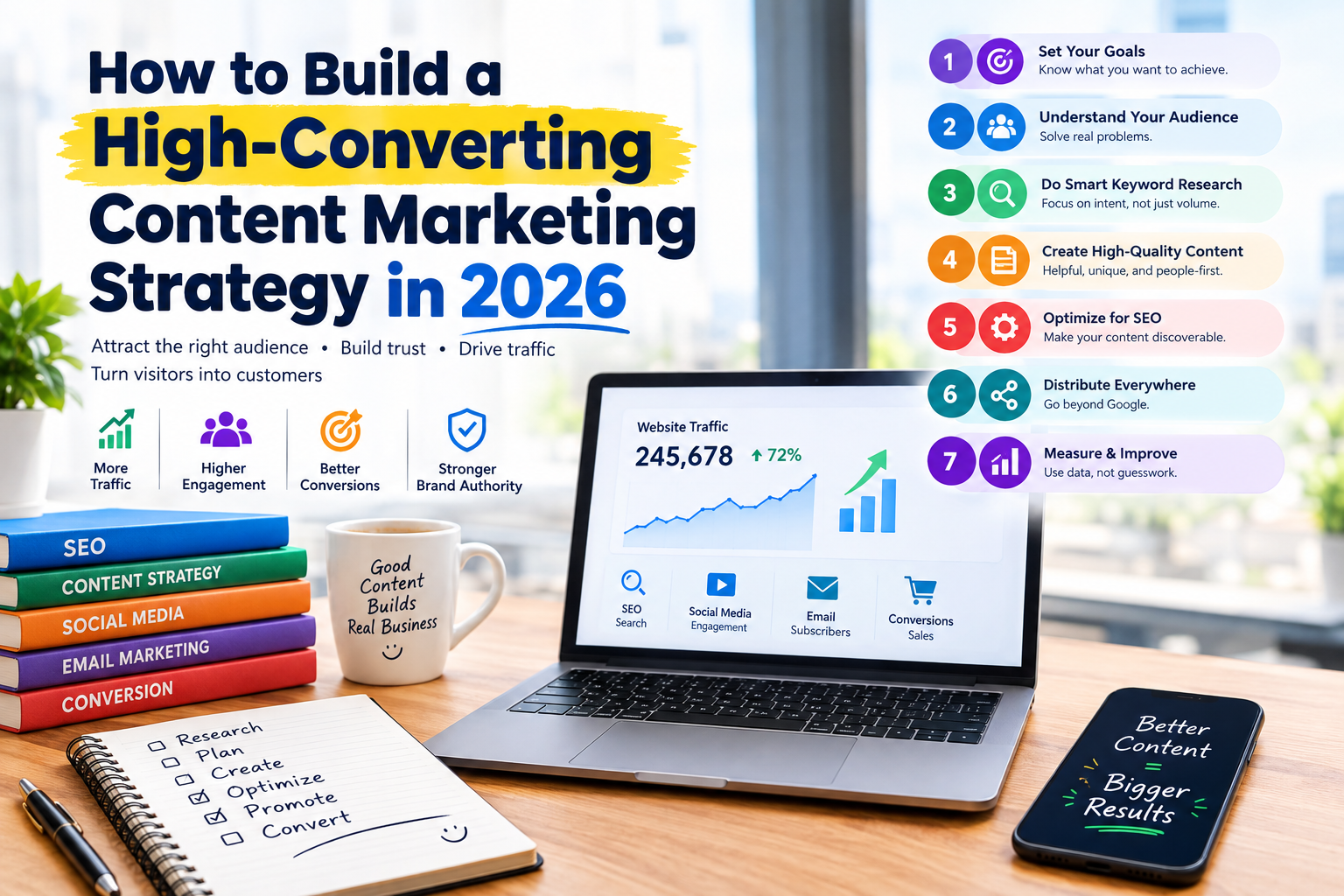
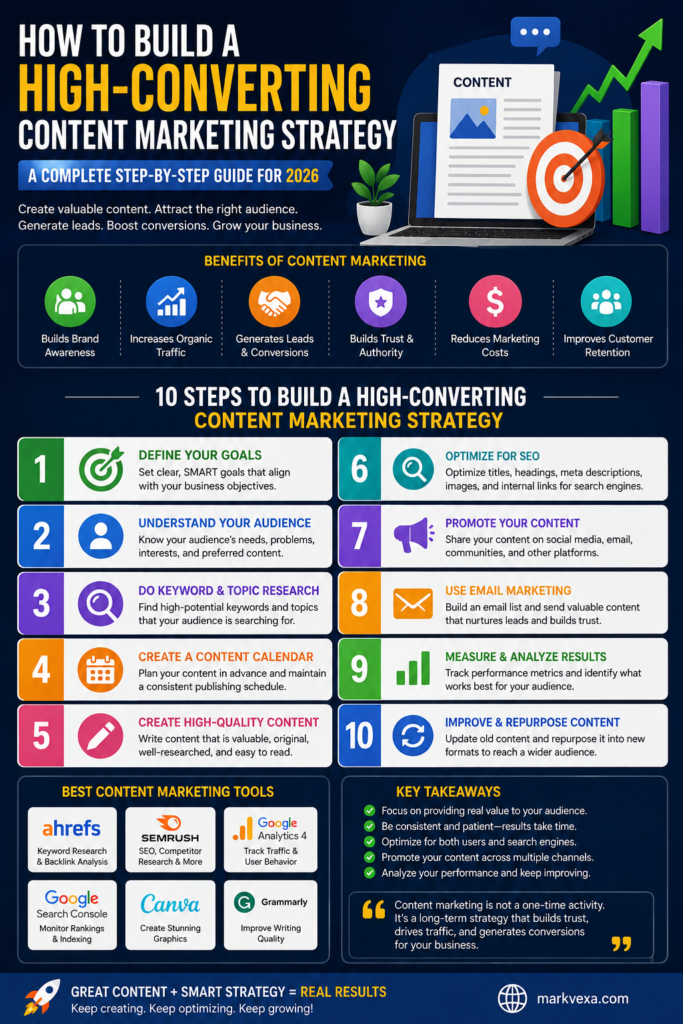
Introduction
Content marketing has become one of the most effective ways to grow a website, build brand authority, and generate consistent traffic without relying entirely on paid advertising.
Whether you’re a blogger, affiliate marketer, small business owner, or digital marketer, creating valuable content helps you connect with your audience at every stage of their buying journey.
However, simply publishing articles isn’t enough. Thousands of new blog posts go live every day, making competition tougher than ever. To stand out, you need a content marketing strategy that focuses on quality, relevance, and user intent.
A well-planned strategy helps you attract the right visitors, increase engagement, improve search engine rankings, and convert readers into customers.
In this guide, you’ll learn how to create a high-converting content marketing strategy step by step.
What Is a Content Marketing Strategy?
A content marketing strategy is a structured plan for creating, publishing, promoting, and managing content that supports your business goals.
Instead of creating content randomly, every article, video, email, or social media post is designed to achieve a specific objective.
These objectives may include:
- Increasing website traffic
- Building brand awareness
- Generating leads
- Growing an email list
- Improving SEO rankings
- Increasing affiliate sales
- Driving product purchases
- Building customer loyalty
An effective strategy ensures that every piece of content has a clear purpose.
Why Content Marketing Matters in 2026
Search engines continue to prioritize helpful, trustworthy, and user-focused content.
At the same time, consumers expect businesses to provide valuable information before asking them to make a purchase.
A strong content marketing strategy helps you:
- Build credibility
- Earn customer trust
- Increase organic traffic
- Generate qualified leads
- Improve search rankings
- Reduce advertising costs
- Support long-term business growth
Unlike paid advertising, quality content can continue generating traffic for months or even years after publication.
Benefits of Content Marketing
Businesses that consistently publish valuable content often experience:
- Higher Google rankings
- More organic visitors
- Better engagement
- Increased brand awareness
- More backlinks
- Higher conversion rates
- Lower customer acquisition costs
- Stronger customer relationships
These benefits make content marketing one of the highest-return digital marketing investments available.
Step 1: Define Your Goals
Before creating any content, decide exactly what you want to achieve.
Without clear goals, it becomes difficult to measure success.
Common content marketing goals include:
Increase Organic Traffic
Publish SEO-optimized content that attracts visitors from Google and other search engines.
Generate Leads
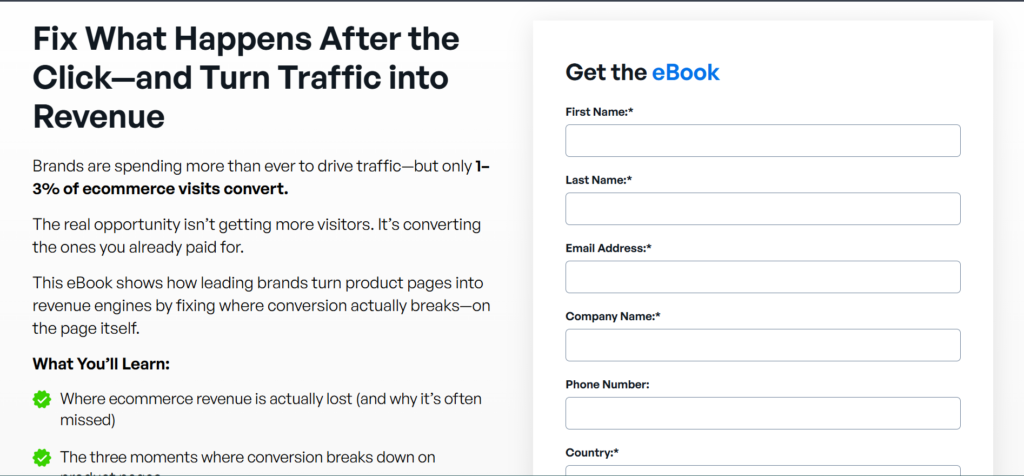
Offer valuable resources such as ebooks, templates, or newsletters in exchange for email addresses.
Increase Affiliate Revenue
Create detailed product reviews, comparisons, and buying guides that help readers make informed purchasing decisions.
Build Brand Authority
Publish expert content that positions your website as a trusted resource in your industry.
Improve Customer Retention
Create educational content that helps existing customers get more value from your products or services.
Use SMART Goals
Your objectives should follow the SMART framework:
- Specific
- Measurable
- Achievable
- Relevant
- Time-bound
Example:
Increase organic website traffic by 30% within the next six months through SEO-focused content marketing.
SMART goals make it easier to track progress and adjust your strategy when needed.
Step 2: Understand Your Target Audience
One of the biggest mistakes marketers make is creating content for everyone.
Successful content speaks directly to a specific audience.
Ask yourself:
- Who are they?
- What problems do they face?
- What questions do they ask?
- What solutions are they looking for?
- Which platforms do they use?
- What motivates their purchasing decisions?
The better you understand your audience, the more relevant your content becomes.
Create a Buyer Persona
A buyer persona is a detailed profile of your ideal customer.
For example:
Audience Profile
- Age: 25–45
- Interests: Digital marketing, SEO, blogging
- Goals: Increase website traffic
- Challenges: Low Google rankings
- Preferred content: Tutorials, reviews, case studies
- Favorite platforms: Google Search, YouTube, Pinterest, LinkedIn
Creating personas helps ensure every piece of content addresses real user needs.
Step 3: Research Your Competitors
Competitor research provides valuable insights into what’s already working in your niche.
Analyze websites that rank well for your target keywords.
Look at:
- Their most popular articles
- Content length
- Headings and structure
- Keywords they target
- Backlinks
- Internal linking strategy
- Content updates
- User engagement
The goal isn’t to copy competitors but to identify opportunities to create even better content.
Find Content Gaps
A content gap is a topic your competitors haven’t covered thoroughly.
You can identify opportunities by asking:
- What questions remain unanswered?
- Which topics lack depth?
- Can you provide newer statistics?
- Can you explain concepts more clearly?
- Can you add practical examples?
Filling these gaps helps your content stand out and provides greater value to readers.
Step 4: Perform Keyword Research
Every successful content strategy begins with keyword research.
Choosing the right keywords ensures you’re creating content people are actively searching for.
Focus on keywords that have:
- Good search volume
- Manageable competition
- Clear search intent
- Business relevance
Excellent keyword research tools include:
- Google Search Console
- Google Keyword Planner
- Ahrefs
- Semrush
- Ubersuggest
- AnswerThePublic
Don’t focus solely on high-volume keywords. Long-tail keywords often have less competition and attract visitors with stronger intent.
Step 5: Create a Content Calendar
One of the biggest reasons content marketing fails is inconsistency.
Publishing one article this week and then disappearing for a month makes it difficult to build momentum with both readers and search engines.
A content calendar helps you stay organized and publish consistently.
Your calendar should include:
- Content title
- Target keyword
- Content type
- Publish date
- Author
- Status
- Promotion channels
Planning your content in advance allows you to maintain quality while ensuring every article supports your overall marketing goals.
Choose the Right Content Types
Not every topic should become a blog post.
A successful content strategy includes different content formats, such as:
Blog Posts
Perfect for:
- SEO
- Organic traffic
- Educational content
Product Reviews
Ideal for:
- Affiliate marketing
- Commercial keywords
- Buying decisions
Comparison Articles
Examples include:
- Ahrefs vs Semrush
- ChatGPT vs Claude AI
- Canva Pro vs Adobe Express
Comparison posts often attract users who are ready to make a purchase.
Ultimate Guides
Long-form guides build authority and earn backlinks.
Examples:
- Complete SEO Guide
- Beginner’s Guide to Affiliate Marketing
- WordPress Optimization Guide
Case Studies
Sharing real experiences increases credibility and trust.
Case studies can demonstrate:
- Traffic growth
- SEO improvements
- Marketing results
- Business success stories
Step 6: Create High-Quality Content
Google rewards content that provides real value.
Every article should answer the reader’s questions better than competing pages.
High-quality content should:
- Solve a specific problem
- Include practical advice
- Be accurate
- Be easy to understand
- Stay up to date
- Offer unique insights
Instead of writing for search engines, write for your audience.
Write Attention-Grabbing Headlines
Your headline determines whether people click your content.
Good headlines are:
- Clear
- Specific
- Benefit-driven
- Keyword-focused
Examples:
✅ How to Build a High-Converting Content Marketing Strategy
✅ 15 Content Marketing Tips That Actually Work
✅ Content Marketing Strategy for Small Businesses
Avoid vague or misleading titles that don’t match the article’s content.
Structure Content for Readability
Readers rarely consume every word on a page. Most people scan content before deciding whether to continue reading.
Improve readability by using:
- Short paragraphs
- Descriptive headings
- Bullet points
- Numbered lists
- Tables where appropriate
- Images and charts
- Highlighted key points
A clean layout keeps visitors engaged and encourages them to stay on your page longer.
Step 7: Optimize Every Article for SEO
Creating great content isn’t enough if search engines can’t understand it.
Each article should include:
SEO Title
Place the primary keyword near the beginning of the title whenever it reads naturally.
Meta Description
Write a compelling summary that encourages clicks and includes your focus keyword.
URL Slug
Keep URLs short and descriptive.
Example:
high-converting-content-marketing-strategy
Headings
Use a logical heading structure:
- H1
- H2
- H3
This improves both readability and search engine understanding.
Images
Every image should have:
- Descriptive file name
- Alt text
- Optimized size
- Fast loading speed
Optimized images can also appear in Google Images and drive additional traffic.
Step 8: Include Strong Calls-to-Action (CTAs)
Even informative content should guide readers toward a next step.
Examples of effective CTAs include:
- Subscribe to our newsletter
- Download our free guide
- Read another related article
- Compare SEO tools
- Try the recommended software
- Contact our team
- Share this article
A clear CTA helps convert visitors into subscribers, leads, or customers.
Build Topic Clusters
Instead of publishing unrelated articles, organize content around central themes.
For example:
Pillar Page
Content Marketing Strategy
Supporting articles:
- Content Marketing for Beginners
- SEO Content Writing Guide
- Email Marketing Tips
- Best Content Marketing Tools
- Content Calendar Templates
- How to Measure Content Performance
Linking these articles together creates a topic cluster that strengthens your site’s authority and helps search engines understand the relationship between your content.
Maintain a Consistent Brand Voice
Your readers should recognize your content regardless of the topic.
Keep your writing:
- Professional
- Helpful
- Clear
- Consistent
- Trustworthy
A consistent tone builds familiarity and encourages readers to return to your website.
Step 9: Promote Your Content Effectively
Creating outstanding content is only half the job. If people don’t discover it, it won’t generate traffic or conversions.
A strong content promotion strategy helps you reach a wider audience and maximize the value of every article you publish.
Some of the most effective promotion channels include:
- Google Search (SEO)
- X (Twitter)
- Quora
- Email newsletters
- Medium
- Industry forums
Publishing once isn’t enough. Promote your content multiple times across different platforms to increase its reach.
Pinterest Marketing
Pinterest is one of the best long-term traffic sources for blogs.
Unlike many social media platforms, Pins can continue generating traffic for months or even years.
Pinterest Best Practices
- Design attractive vertical pins
- Write keyword-rich titles
- Add detailed descriptions
- Include relevant hashtags
- Link directly to your article
- Publish consistently
- Join niche-specific boards
For example, if you publish an article about SEO, create multiple Pinterest designs linking to the same post.
Email Marketing
Email remains one of the highest-converting marketing channels.
Instead of depending only on search engines, build your own email list.
Ways to grow your list include:
- Free ebooks
- Checklists
- Templates
- Exclusive guides
- Newsletters
- Mini courses
Once people subscribe, send valuable content regularly rather than constant promotional emails.
Social Media Distribution
Every new article should be shared across your social platforms.
Repurpose the same content into:
- Short videos
- Infographics
- Carousel posts
- Quote graphics
- Threads
- Tips
This allows one article to generate traffic from multiple channels.
Step 10: Measure Your Results
Without tracking performance, it’s impossible to know what’s working.
Monitor your content using reliable analytics tools.
Key metrics include:
- Organic traffic
- Page views
- Average engagement time
- Bounce rate
- Conversion rate
- Click-through rate (CTR)
- Returning visitors
- Keyword rankings
- Backlinks earned
Review these metrics regularly and use the insights to improve future content.
Best Tools for Content Marketing
Professional marketers rely on specialized tools to improve productivity and results.
Google Search Console
Use it to:
- Monitor keyword performance
- Check indexing status
- Identify technical issues
- Improve CTR
Google Analytics 4
Track:
- User behavior
- Traffic sources
- Conversions
- Engagement metrics
Ahrefs
Ideal for:
- Keyword research
- Backlink analysis
- Competitor research
- Rank tracking
Semrush
Excellent for:
- SEO campaigns
- Content optimization
- PPC research
- Competitor analysis
Canva
Perfect for:
- Blog graphics
- Pinterest Pins
- Infographics
- Social media images
Grammarly
Helps improve:
- Grammar
- Readability
- Clarity
- Professional writing quality
Common Content Marketing Mistakes
Avoid these common mistakes that can limit your results:
- Publishing without a strategy
- Ignoring keyword research
- Writing only for search engines
- Using clickbait titles
- Neglecting SEO optimization
- Failing to promote content
- Publishing inconsistent content
- Not updating older articles
- Ignoring analytics
- Forgetting clear calls-to-action
Learning from these mistakes can save time and improve your long-term performance.
Tips to Increase Conversions
Traffic alone isn’t enough. Your content should encourage readers to take action.
Improve conversions by:
- Writing compelling headlines
- Solving real problems
- Including trust signals
- Adding testimonials or case studies
- Using clear calls-to-action
- Improving page speed
- Optimizing for mobile devices
- Reducing distractions
- Making navigation simple
The easier it is for users to take the next step, the higher your conversion rate will be.
Frequently Asked Questions
How often should I publish content?
Consistency is more important than volume. Publishing one or two high-quality articles each week is often more effective than publishing many low-quality posts.
How long should a blog post be?
It depends on the topic. For competitive keywords, comprehensive articles between 2,000 and 3,500 words often perform well when they fully answer the user’s query.
Is SEO important for content marketing?
Yes. SEO helps your content become discoverable through search engines, bringing consistent organic traffic over time.
Can AI help with content marketing?
Yes. AI can assist with brainstorming, outlining, and drafting content. However, every article should be reviewed, fact-checked, and enhanced with original insights before publishing.
How long does content marketing take to produce results?
Content marketing is a long-term strategy. Many websites begin seeing measurable improvements within 3–6 months, while stronger authority and traffic growth often develop over a longer period through consistent publishing and optimization.
Final Verdict
A successful Content Marketing Strategy is built on understanding your audience, creating valuable content, optimizing it for search engines, and promoting it consistently across multiple channels.
There is no single tactic that guarantees success. Instead, the best results come from combining SEO, audience research, content planning, effective promotion, and continuous improvement.
By following the strategies in this guide, you can build a content marketing system that attracts qualified visitors, strengthens your brand, increases conversions, and supports long-term business growth.
Key Takeaways
- Set clear, measurable goals before creating content.
- Understand your audience and their search intent.
- Perform thorough keyword and competitor research.
- Publish high-quality, SEO-optimized content consistently.
- Organize articles into topic clusters.
- Promote content through SEO, Pinterest, email, and social media.
- Track performance using analytics tools.
- Update older content to maintain rankings.
- Focus on delivering genuine value to your audience.
SEO Meta Description
Learn how to build a high-converting Content Marketing Strategy in 2026. Discover proven techniques for planning, creating, optimizing, promoting, and measuring content that drives more traffic, leads, and conversions.
Focus Keyword
Content Marketing Strategy
SEO Title
How to Build a High-Converting Content Marketing Strategy in 2026
URL Slug
high-converting-content-marketing-strategy
Suggested Internal Links
- SEO Techniques to Rank Higher on Google
- Best SEO Tools for Beginners
- Ahrefs Review 2026
- Semrush Review 2026
- Email Marketing Best Practices
- Keyword Research Guide
- On-Page SEO Checklist
- Best AI Writing Tools
Suggested External Links
- Google Search Central
- Google Analytics
- Google Search Console
- HubSpot Marketing Resources
- Content Marketing Institute
Refresh Existing Content
One of the easiest ways to increase organic traffic is by updating older articles.
Instead of always creating new content, improve pages that already receive traffic.
Update:
- Statistics
- Screenshots
- Examples
- Internal links
- External references
- SEO titles
- Meta descriptions
- FAQs
Google often rewards fresh, accurate, and up-to-date content.
Repurpose Your Content
A single blog post can become multiple pieces of content.
For example:
One article can become:
- Pinterest Pins
- Instagram Carousels
- LinkedIn Posts
- Facebook Posts
- X (Twitter) Threads
- YouTube Videos
- YouTube Shorts
- TikTok Videos
- Email Newsletters
- Infographics
Repurposing content increases its reach without requiring you to create everything from scratch.
Build Trust With EEAT
Google values websites that demonstrate:
- Experience
- Expertise
- Authoritativeness
- Trustworthiness
You can strengthen your EEAT by:
- Publishing accurate information
- Citing reliable sources
- Showing real experience
- Updating content regularly
- Creating a professional About page
- Adding author information
- Displaying contact details
- Maintaining transparent policies
Trust is one of the most important factors in long-term content marketing success.
Best Content Marketing Tools
The right tools can save time and improve your workflow.
Ahrefs
Perfect for:
- Keyword research
- Competitor analysis
- Backlink tracking
Semrush
Ideal for:
- SEO optimization
- Content ideas
- Site audits
- Rank tracking
Google Analytics 4
Use it to monitor:
- User behavior
- Traffic sources
- Conversions
Google Search Console
Essential for:
- Keyword performance
- Indexing
- Technical SEO
Canva
Great for:
- Blog images
- Pinterest Pins
- Infographics
- Social media graphics
Grammarly
Helps improve:
- Grammar
- Clarity
- Readability
Common Mistakes to Avoid
Many content marketers fail because they make avoidable mistakes.
Avoid:
- Publishing without a strategy
- Ignoring SEO
- Writing only for search engines
- Poor keyword research
- Weak headlines
- Slow website speed
- No internal linking
- Poor mobile experience
- Inconsistent publishing
- Never updating old content
Correcting these issues can significantly improve your results.
Frequently Asked Questions
How long does content marketing take to work?
Content marketing is a long-term strategy. Many websites start seeing meaningful results within 3 to 6 months, depending on competition, content quality, and consistency.
Is content marketing better than paid advertising?
They work best together. Paid ads can generate immediate traffic, while content marketing builds sustainable organic traffic over time.
How often should I publish content?
Quality is more important than quantity. Publishing one or two well-researched articles each week is often more effective than publishing low-quality content daily.
Does content marketing improve SEO?
Yes. High-quality content optimized for search intent and relevant keywords helps improve visibility, attract backlinks, and increase organic traffic.
What is the best content marketing strategy?
The best strategy combines:
- Audience research
- Keyword research
- SEO optimization
- Consistent publishing
- Content promotion
- Performance analysis
- Continuous improvement
Final Verdict
Building a high-converting Content Marketing Strategy requires planning, consistency, and a deep understanding of your audience. It’s not enough to publish articles—you need to create content that solves real problems, is optimized for search engines, and is actively promoted across multiple channels.
By following the strategies in this guide, you can build a content system that attracts qualified visitors, strengthens your authority, and generates long-term traffic, leads, and conversions.
Content marketing is one of the most valuable long-term investments you can make for your website. Stay consistent, monitor your results, and continue improving your content to achieve sustainable growth.