Introduction
Search engine optimization (SEO) continues to evolve every year, and 2026 is no exception. Google’s algorithms are smarter than ever, rewarding websites that provide valuable, trustworthy, and user-focused content while filtering out low-quality pages.
Whether you run a personal blog, an affiliate marketing website, an online store, or a business website, ranking on the first page of Google can dramatically increase your visibility, generate consistent organic traffic, and help grow your brand without relying heavily on paid advertising.
However, achieving high rankings isn’t about chasing shortcuts. Instead, it requires a combination of technical optimization, strategic content creation, and an understanding of how users search online.
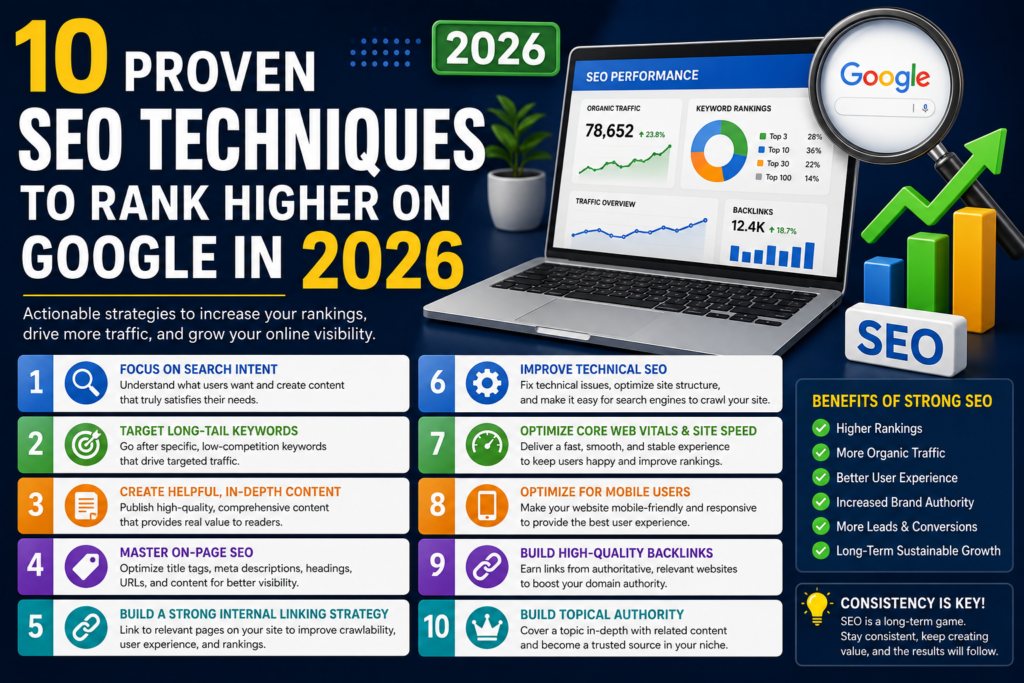
In this guide, we’ll explore 10 proven SEO techniques that continue to deliver results in 2026. These strategies are practical, beginner-friendly, and based on SEO best practices that work across different industries.
Why SEO Still Matters in 2026
Many people believe AI has replaced SEO, but the reality is different.
Artificial intelligence has changed how content is created and how search engines evaluate websites, but SEO remains one of the most effective long-term digital marketing strategies.
A well-optimized website can:
- Generate free organic traffic
- Build brand authority
- Increase leads and conversions
- Reduce advertising costs
- Improve user experience
- Create sustainable long-term growth
Unlike paid ads, which stop delivering traffic when your budget runs out, strong SEO can continue attracting visitors for months or even years.
What Has Changed in SEO?
Google now focuses more on content quality than ever before.
Instead of simply matching keywords, Google’s algorithms analyze:
- Search intent
- Content quality
- User experience
- Website authority
- Page speed
- Mobile usability
- Internal linking
- Helpful information
- Freshness of content
This means websites that genuinely help users are more likely to rank than websites created only for search engines.
Technique #1: Focus on Search Intent
One of the biggest ranking factors in 2026 is search intent.
Search intent refers to the reason behind a user’s search query.
For example:
Someone searching for:
“Best laptops for students”
expects product recommendations.
Someone searching:
“How to clean a laptop keyboard”
expects a step-by-step tutorial.
If your content doesn’t match what users expect, it will struggle to rank—even if it’s well-written.
Types of Search Intent
- Informational
- Navigational
- Commercial Investigation
- Transactional
Understanding the intent behind a keyword helps you create content that satisfies users and improves engagement.
How to Optimize for Search Intent
Before writing an article:
- Search your target keyword on Google.
- Analyze the top-ranking pages.
- Identify the type of content ranking.
- Match your article to user expectations.
- Answer the main question quickly.
This simple process significantly increases your chances of ranking.
Technique #2: Target Long-Tail Keywords
Many beginners make the mistake of targeting highly competitive keywords.
For example:
Instead of targeting:
SEO
Try targeting:
- SEO techniques for beginners
- Best SEO tips for small businesses
- SEO checklist for WordPress
- How to rank on Google in 2026
Long-tail keywords usually:
- Have lower competition
- Convert better
- Match user intent
- Are easier to rank for
Although they often have lower search volume individually, together they can generate a substantial amount of targeted traffic.
How to Find Long-Tail Keywords
You can discover valuable keyword opportunities using tools like:
- Google Autocomplete
- Google Search Console
- Ahrefs
- Semrush
- Ubersuggest
- AnswerThePublic
- Google “People Also Ask”
Look for keywords with:
- Moderate search volume
- Low competition
- High relevance to your audience
- Clear search intent
These keywords provide the best opportunities for newer websites.
Technique #3: Create Helpful, In-Depth Content
Google’s Helpful Content systems reward articles that genuinely solve readers’ problems.
Instead of publishing short articles that barely answer a question, create comprehensive resources that cover a topic from multiple angles.
High-quality content should:
- Answer the user’s main question early
- Explain concepts clearly
- Include practical examples
- Use accurate and up-to-date information
- Be easy to read
- Offer actionable advice
The goal is to become the most useful resource on the topic.
Write for Humans First
Many websites still focus too much on keywords.
Instead, write naturally.
Use your focus keyword where it fits, but avoid overusing it.
A good article should feel like it was written to help a real person—not to manipulate search rankings.
Google increasingly rewards content that provides a positive reading experience.
Improve Readability
Visitors are more likely to stay on your page if your content is easy to scan.
Improve readability by:
- Using short paragraphs
- Writing clear headings
- Including bullet points
- Using simple language
- Highlighting important information
- Breaking up long sections
A well-structured article keeps readers engaged and can improve metrics such as time on page.
Technique #4: Master On-Page SEO
On-page SEO remains one of the easiest ways to improve your rankings because you have full control over it.
Proper optimization helps search engines understand what your content is about while making it easier for users to read.
Optimize Your Title Tag
Your title is one of the first things users notice in search results.
A strong title should:
- Include your primary keyword
- Be clear and descriptive
- Stay under 60 characters
- Encourage users to click
Example:
✅ 10 Proven SEO Techniques to Rank Higher on Google in 2026
Write an Engaging Meta Description
Although meta descriptions aren’t a direct ranking factor, they can improve your click-through rate (CTR).
A good meta description should:
- Include the focus keyword
- Summarize the article
- Encourage readers to click
- Stay between 150–160 characters
Use Proper Heading Structure
Organize your content with headings.
A good structure looks like this:
- H1 – Main Title
- H2 – Main Sections
- H3 – Subsections
- H4 – Additional details when necessary
A clear hierarchy improves readability for both users and search engines.
Optimize Your URL
Short, descriptive URLs are easier to understand.
Example:
Good
yourwebsite.com/seo-techniques-2026
Avoid
yourwebsite.com/post?id=58492&cat=seo2026
Naturally Include Keywords
Use your focus keyword in:
- Title
- First paragraph
- At least one H2 heading
- URL
- Meta description
- Image alt text
- Conclusion
Avoid keyword stuffing. Write naturally for your audience.
Technique #5: Build a Strong Internal Linking Strategy
Internal links help search engines discover your content while guiding visitors to related pages.
A good internal linking strategy can:
- Improve crawlability
- Increase page views
- Keep users on your website longer
- Distribute link authority across your site
- Help new articles get indexed faster
For example, if you’re writing about SEO techniques, you can link to:
- Keyword Research Guide
- On-Page SEO Checklist
- Best SEO Tools
- Ahrefs Review 2026
- Semrush Review 2026
Use descriptive anchor text instead of generic phrases like “click here.”
Technique #6: Improve Technical SEO
Even the best content can struggle if your website has technical problems.
Technical SEO ensures search engines can crawl and index your pages efficiently.
Important areas include:
- XML sitemap
- Robots.txt
- HTTPS security
- Canonical URLs
- Structured data (Schema Markup)
- Crawl error fixes
- Clean website architecture
Regular technical audits help identify issues before they affect your rankings.
Improve Website Speed
Page speed directly affects user experience and search performance.
A slow website can increase bounce rates and reduce conversions.
Ways to improve speed include:
- Compress images
- Use browser caching
- Enable GZIP compression
- Minify CSS and JavaScript
- Remove unused plugins
- Choose reliable web hosting
- Use a Content Delivery Network (CDN)
Fast websites provide a better experience for visitors and are more likely to perform well in search results.
Optimize for Core Web Vitals
Core Web Vitals measure how users experience your website.
Google focuses on three key metrics:
Largest Contentful Paint (LCP)
Measures how quickly the main content loads.
Aim for under 2.5 seconds.
Interaction to Next Paint (INP)
Measures how responsive your website is when users interact with it.
Lower response times generally provide a smoother user experience.
Cumulative Layout Shift (CLS)
Measures visual stability.
Avoid elements that unexpectedly move while a page is loading.
Improving these metrics can lead to a better user experience and support stronger SEO performance.
Technique #7: Optimize for Mobile Users
More than half of all web traffic comes from smartphones and tablets.
Google primarily uses the mobile version of your website for indexing and ranking.
A mobile-friendly website should have:
- Responsive design
- Readable text without zooming
- Fast loading times
- Clickable buttons
- Proper spacing between links
- Mobile-friendly navigation
Always test your pages on multiple devices to ensure a consistent experience.
Technique #8: Optimize Images for SEO
Images make your content more engaging, but poorly optimized images can slow down your website.
Best practices include:
- Use descriptive file names
- Add meaningful alt text
- Compress images before uploading
- Choose modern formats like WebP when possible
- Use appropriate image dimensions
- Enable lazy loading
Technique #9: Build High-Quality Backlinks
Backlinks remain one of Google’s strongest ranking signals. However, in 2026, quality matters far more than quantity.
A few backlinks from trusted, relevant websites are much more valuable than hundreds of low-quality links.
Effective Ways to Earn Quality Backlinks
- Publish original research and statistics
- Create comprehensive guides
- Write guest posts for reputable websites
- Build free tools or templates
- Create infographics
- Reach out to websites that mention your brand
- Replace broken links with your content
- Promote your best articles through email outreach
Avoid buying backlinks or participating in link schemes, as these practices violate Google’s guidelines and may lead to ranking penalties.
Technique #10: Build Topical Authority
Google increasingly rewards websites that demonstrate expertise across an entire topic rather than focusing on isolated articles.
For example, if your niche is SEO, don’t publish just one article about SEO. Create a complete content hub that covers related topics such as:
- Keyword Research
- On-Page SEO
- Technical SEO
- Link Building
- Local SEO
- SEO Tools
- Content Marketing
- Google Search Console
- Core Web Vitals
- SEO Case Studies
When your articles are connected through strategic internal links, search engines gain a clearer understanding of your expertise.
Refresh Your Existing Content
SEO isn’t just about publishing new articles. Updating existing content is equally important.
Refreshing older posts can:
- Improve rankings
- Increase organic traffic
- Keep information accurate
- Maintain relevance
- Boost user engagement
When updating content:
- Add new statistics
- Update screenshots
- Improve readability
- Expand sections with new insights
- Remove outdated information
- Add new internal links
- Optimize for current search intent
Google often rewards fresh, relevant content, especially for topics that evolve quickly.
Use AI Responsibly
Artificial intelligence has become a valuable tool for content creation and SEO research. However, AI-generated content should always be reviewed and enhanced by a human.
Best practices include:
- Use AI for brainstorming ideas
- Generate outlines and first drafts
- Fact-check all information
- Add original examples and insights
- Maintain your brand’s voice
- Ensure the final content is accurate and genuinely helpful
The goal is to create content that serves readers, not just search engines.
Common SEO Mistakes to Avoid
Even experienced website owners make mistakes that can limit their rankings.
Avoid these common issues:
- Keyword stuffing
- Publishing thin or duplicate content
- Ignoring search intent
- Slow website speed
- Poor mobile experience
- Missing title tags and meta descriptions
- Broken internal links
- Neglecting technical SEO
- Using misleading titles
- Failing to update older content
Regular SEO audits can help identify and fix these problems before they impact your performance.
SEO Checklist for 2026
Before publishing any article, make sure you’ve completed the following:
- Keyword research completed
- Search intent matched
- SEO-friendly title written
- Meta description added
- Short, descriptive URL created
- Proper heading structure (H1, H2, H3)
- Images optimized with alt text
- Internal links included
- External links to authoritative sources added
- Mobile responsiveness checked
- Page speed optimized
- Grammar and spelling reviewed
- Content proofread and fact-checked
Following this checklist consistently can improve both user experience and search visibility.
Frequently Asked Questions (FAQs)
How long does SEO take to show results?
SEO is a long-term strategy. Many websites begin to see improvements within 3–6 months, although highly competitive niches may take longer depending on content quality, competition, and website authority.
Are backlinks still important in 2026?
Yes. High-quality backlinks continue to be an important ranking factor. Focus on earning links naturally from reputable and relevant websites.
Is keyword research still necessary?
Absolutely. Understanding what your audience is searching for is essential for creating content that meets user needs and performs well in search results.
Can AI replace SEO?
No. AI can assist with research, planning, and drafting, but successful SEO still depends on high-quality content, technical optimization, user experience, and human expertise.
What’s the most important SEO technique?
There isn’t a single technique that guarantees success. The best results come from combining helpful content, strong on-page SEO, technical optimization, quality backlinks, and a positive user experience.
Final Verdict
SEO in 2026 is about creating value for users while making it easy for search engines to understand and trust your content.
By focusing on search intent, publishing comprehensive articles, improving technical performance, building high-quality backlinks, and establishing topical authority, you can create a strong foundation for long-term organic growth.
Remember that SEO is not a one-time task. It requires continuous improvement, regular updates, and a commitment to delivering helpful, accurate information.
If you apply these 10 proven SEO techniques, you’ll be well-positioned to improve your Google rankings, increase organic traffic, and build a website that continues to grow over time.
Key Takeaways
- Prioritize search intent over keyword stuffing.
- Target long-tail keywords with realistic ranking potential.
- Publish comprehensive, user-focused content.
- Optimize every page with strong on-page SEO.
- Maintain excellent technical SEO and Core Web Vitals.
- Build authoritative backlinks naturally.
- Develop topical authority through related content.
- Refresh older articles to keep them relevant.
- Use AI as a productivity tool—not a replacement for expertise.
- Monitor your SEO performance and improve continuously.